
This Gilman School: an all boy prep school that Harrison Mack attended
"Harrison--a fine, muscular, sun-bronzed, gentle-eyed, patrician-nosed, steak-fed, Gilman-Schooled, soft spoken, well tailed aristocrat" (21)
http://www.gilman.edu
Gilman is an academically-rigorous, athletic power house that prides itself on honor, respect, integrity, humility, and excellence. (I know all of this because my brother is a senior here) I think why Barth chose this school for Harrison Mack because at the time, Gilman was the elite school for wealthy Baltimorons to send their sons. It embodies all of what Harrison's father valued.
http://www.guilfordassociation.org/community/photos.php
http://www.rolandpark.org/ThenAndNowNorth
Guilford is the neighborhood that Harrison Mack grew up in. Todd comments on his relationship with Harrison as, "I learned later, he was attracted by my transcendent rejection of the thing that mean life to him. in short, we were soon friends, and walked blindly to my rooms at darn for more drinks, singing the Internationale in French through the mansioned and junipered roads of Guilford" (21).

the pictures above and below are basically what the neighborhood looks like. The community was planned under "the suburban setting" with usable space devoted to each lot for the residents. The houses/ roads/ small parks in the neighborhood were completed by 1925. It was popular for people to move into the neighborhoods around WWI era.


above: Cold Spring Lane (major road in between the neighborhoods Guilford and Roland Park 1939)
below: Cold Spring Lane 2010

Johns Hopkins keeps getting mentioned throughout the book...Here is what the Homewood Campus looks like. This is where the undergrad campus is.
"So I went to Johns Hopkins, enrolled in the pre-law curriculum. At Dad's suggestion I joined a fraternity--Beta Alpha" (129)

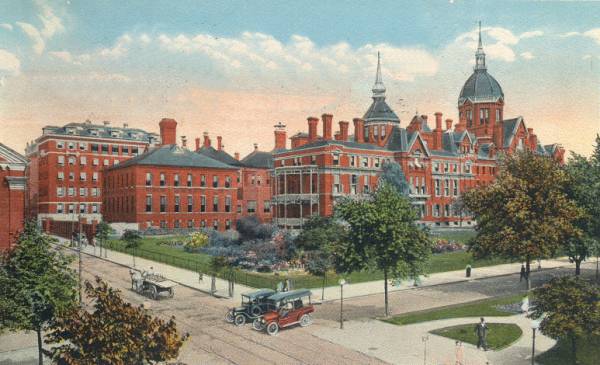
This is Johns Hopkins hospital, which is located 20 minutes away from the Homewood campus. This is where Marvin Rose was a medical student. The medical students, residents, and some doctors lived around the campus, making the surrounding area an almost exclusive Hopkins neighborhood. They used the require all residents to live in this area because then they were always 5 minutes away from the hospital. (Both my grandfathers lived in this neighborhood during their early Hopkins days).
"I had a marvelous fourth-floor room in an ancient row house--it must once have been palatial--on Monument Street, very near Hopkins Hospital: a room suggested to me by Marvin Rose" (131)
below is a modern picture of the row houses on Monument Street.

X. The Law
what are Todd's feelings toward the law?
-"I have no general opinion about the law, or about justice, and if I sometimes set little obstacles, books and slants, in the path of the courts, it is because I'm curious, merely, to see what will happen...winning or losing litigations is of no concern to me" (85)
The Mack Inheritance Case:
-senior Mack left a large estate to an undetermined inheritor because he made and revised so many wills that many parties have a stake in the estate.
"now of the several characteristics of Harrison pere, three were important to the case: he was in the habit of using his wealth as a club to keep his kin in line; he was, apparently, addicted to drawing up of wills; and, especially in his last years, he was obsessively jealous of the products of his mind and body, and permitted none to be destroyed" (86)
-who's involved (interested parties):
- Harrison Mack--represented by Todd
- ultimately loses because of his donations to the Spanish government "a blue blood with e Red heart" (94)
- Mother Mack (Elizabeth Sweetman Mack)
- winner (91-92)
- the nurses
- the Mack's neighborhood church
the rematch: How does Todd ultimately win the lawsuit?
- 'Stacia's letters (107)
-do his actions to help Harrison contradict or comment on his description of his relationship with the law?
-"An excellent morning's work for one's last morning on earth, I should say. My friend Harrison is three million dollars richer for it" (108)
- why does he do this on "his last day"
XI. An instructive, if sophisticated, observation
He walks past two dogs having sex in front of a funeral...how does he use this scene to comment on his life philosophy?
-"Develop if you can, the technique of the pallbearers and myself: smile, to be sure--for fucking dogs are truly funny--but walk on and say nothing, as though you hadn't notice" (111)
Does this instance with animals have anything to do with his post-war perception of humans as animals?
XII. A chorus of oysters
How does Todd describe Capt. Osborn and his colleagues?
-" they were a chorus of ancient oysters, stolidly regarding the fish that swam through their ken. Their infrequent voices were slow, nasal, high-pitched, and senile" (112)
The old men sun themselves on a bench and comment on the life passing by them. They comment on the funeral mentioned in XI. The funeral is for Clarence Wampler's wife who "died Monday night" (113). The two dogs are mentioned again and Todd mentions how the two dogs remind him of his seventeenth birthday.
"I chuckled too, and would have stayed to watch, but it was almost eleven-fifteen. I chuckled all the way up Poplar Street toward Marvin Rose's office, thinking of animals in coito and of what had occurred in my bedroom on my seventeenth birthday. behind my back I heard the oysters busily ingesting Cambridge" (116).
Does Todd's descriptions of "the oysters" make any comment on his perception of old age?
XIII. A Mirror Up to Life
This chapter explores Todd's relationship with Betty June. A girl he befriends because she is in love with one of his neighbors, Smitty. Betty June is deeply in love with Smitty, doesn't know she exists. One day Betty June finds out that Smitty is married (121-122). Betty June is extremely upset and vulnerable. She and Todd have sex upstairs in his room, this being Todd's first sexual experience. He catches a glimpse of the act in the mirror and can't stop laughing, making Betty June cry and leave.
-"This was the first. Nothing, to me, is so consistently, profoundly, earth-shakenly funny as we animals in the act of mating. Reader, if you are young and would live on love; if in the flights of intercourse you feel that you and your beloved are models for a Phidias--then don't include among the trappings of your love-nest a good plate mirror" (124).
--Why does Todd make another reference to humans as animals? Is there a connection between this experience and his war experience?
XIV. Bottles, needles, knives
He explains his trip to visit Marvin Rose as an example of his habit of habit-breaking. He explains how he found out about his infection after a night of drunken behavior. He then pauses this story to discuss his journey home from the war.
Barth uses different senses, especially sounds to describe how he found out about his bad heart (126). This is how he found out he could potentially die at any moment.
----"My first impulse, after discharge, was to rush home as quickly as possible, in order to say farewell to Dad and my town before I fell dead" (127)
He can't bring himself to tell his father, who treats him affectionately requesting that he takes a vacation and then go to school. He decides to please his father by attending Johns Hopkins and then Maryland law, following in his father's footsteps.
His college days:
Through his fraternity experience he learned "to drink the most whiskey, fornicate the most girls, get the least sleep, and make the highest grades" (130)
what he got out of college--"I had gained a capacity for liquor and work; an ability to take beatings; a familiarity with card games, high society, and whorehouses; a taste of art and Marxism; and a habit of thinking that would ultimately lead me at least beyond the latter. My college years are as interesting, to me, as my time in the Army, but no more of them than what I've mention is relevant here" (131)
-Are his college days an example of how "everything...is significant, and nothing is finally important" ? (6)
He re encounters Betty June in a whorehouse in Baltimore in 1917. Here she attempts to kill him with a broken bottle. There is a struggle between the two of them, and Betty June calls for the bouncer. Todd is put in the backseat of a car and finds Marvin who takes care of him. He finds out he has an infected prostate and this experience with Betty June drastically altered his life mentality. It altered his outward attitude towards life. (p. 138-139)
-"The visible effects on my behavior were primarily these: I still drank, but no longer got drunk. I smoked, but not nervously. I took women to bed only in rare cases when it was they who assumed the initiative, and then I was thorough but dispassionate. I studied and worked hard and steadily, but no long intensely. I talked less...I unconsciously began to regard my fellow man variously as more of less pacific animals among whom it was generally safe to walk or as a colony of more or less quiet lunatics among whom it was generally safe to live" (138-139)
What points in his life does Todd lose faith in humanity and why?
XV. That puckered smile
This is the analysis of the story of how Todd met Betty June again in a whorehouse in Baltimore.
He explains his interpretation of Betty June's actions: "She wanted to kill me, I see now, for having laughed that time in my bedroom" (142).
He believes that Betty June offered her body to him as a gift after her ego was wounded from Smitty's wedding to Mona. When Todd laughed at her, he thinks that she interpreted this as a personal insult.
He goes on to explain the significance of her puckered smile. He gives many possible interpretations to come to the conclusions he doesn't understand her actions. "Betty June's intentions would have been obvious. To me they were not" (144)
-p. 144 he makes a comment that the fact that it is not clear to him may mean that it is clear to others. He says that this theme may plan a larger role in other chapters and the book as a whole. Is this a comment on how when we read a book we have our own interpretations of the content leading a very personal experience with a novel?
XVI. The Judge's lunch
In this chapter we are re-introduced to Harrison Mack and Todd's relationship. Harrison knows of Todd and Jane's relationship and makes a comment about the note that he left her this morning. Harrison is mad that Todd suggested that Jane should sleep with cap'n Osborn as a last send off. Todd explains Jane's response: "she said she'd do what I asked if I'd agree to let Marvin Rose look at me" (147) We also learn of Jeannine. We get a character description of Harrison (149-150) where Todd says, "if I could be any person I chose, I should not choose to be Todd Andrews at all. I should choose to be very much like my friend Harrison Mack" (144)
-why does he want to be like Harrison Mack? What qualities does Harrison have that Todd wishes he had?
XVII. The end of the outline
Toddy explains how the friendship between himself and the macks terminated over his relationship with Dorothy Miner. This relationship was resumed when Jane found out she was pregnant. Jane does not know how the father is (Harrison or Todd) because she was sleeping with both men and not using protection. Harrison and Jane were worried that if the child was Todd's they would not be good parents. This turned out to not be the case, and they decided that in the end they expected too much out of Todd. The two factors to regaining the friendship: Jane's pregnancy, and Harrison's father's death. At the end of the chapter, Todd and Jane start their relationship over again.
-why does Todd mention the break off of this relationship with the Macks?
-How does the relationship with the Macks affect him?
XVIII. A matter of life or death
Mister Haecker comes and visits Todd in his room. They discuss their opinions of old age. Todd believes that Mister Haecker is fooling himself about his content with death.
-"you've tried to pretend you're enjoying yourself and looking forward to death as a grand finale, when actually you're not" (165)
Mister Haecker and Todd talk about their feelings towards suicide...What are Todd's opinion on death? Does this give an incite on why he wants to commit suicide?
-----"Unless a man subscribes to some religion that doesn't allow it, the question of whether or not to commit suicide is the first question he has to answer before he can work things out for himself." (168)
-----"Nothing has intrinsic value, I remarked, as coolly as though I'd known it for years" (169)

No comments:
Post a Comment